In What Ways Does Breastfeeding Impact Families and Societies?

Two early 20th century Korean women breastfeeding their babies while working
The history and culture of breastfeeding traces changing social, medical and legal attitudes to breastfeeding, the deed of feeding a child breast milk directly from breast to oral fissure. Breastfeeding may exist performed by the infant'southward female parent or by a surrogate, typically chosen a wet nurse.
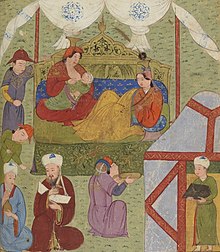
Breastfeeding is the natural means by which a babe receives nourishment. In most societies women ordinarily nurse their own babies, this existence the most natural, convenient and cost-effective method of feeding a baby. Yet, there are situations when a mother cannot suckle her own infant. For example, she may have died, become unwell or otherwise cannot produce breast milk. Earlier the availability of infant formula, in those situations, unless a wet nurse was found promptly, the baby might die, and infant mortality rates were high. Wet nurses were a normal office of the social gild, though social attitudes to wet nursing varied, as well as to the social status of the moisture nurse. Breastfeeding itself began to be seen as common; as well common to be done past royalty, even in ancient societies, and wet nurses were employed to breastfeed the children of regal families. This attitude extended over fourth dimension, specially in western Europe, where babies of noble women were often nursed by wet nurses. Lower-class women breastfed their infants and used a wet nurse but if they were unable to feed their own babe.[ane]
Attempts were made in 15th-century Europe to use cow or goat milk, but these attempts were non successful. In the 18th century, flour or cereal mixed with broth were introduced equally substitutes for breastfeeding, but this was also unsuccessful. Improved infant formulas appeared in the mid-19th century, providing an alternative to wet nursing, and even breastfeeding itself.[1]
During the early 20th century, breastfeeding started to be viewed negatively, particularly in Canada and the United states, where it was regarded every bit a low grade and uncultured practice.[2] The utilise of infant formulas increased, which accelerated after Globe War Ii. From the 1960s onwards, breastfeeding experienced a revival which continued into the 2000s, though negative attitudes towards breastfeeding were still entrenched upward to 1990s.[two]
Early history [edit]

Old-Babylonian plaque of a sitting woman breastfeeding her infant, from Southern Mesopotamia, Iraq

Moche ceramic vessel showing a woman breastfeeding. Larco Museum Collection. Lima-Perú
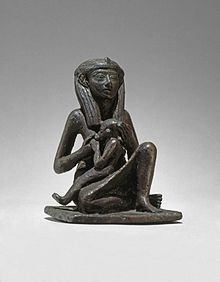
Princess Sobeknakht Suckling a Prince, ca. 1700-after 1630 B.C.E Brooklyn Museum
In the Egyptian, Greek and Roman empires, women unremarkably fed simply their own children. However, breastfeeding began to be seen as something too common to be done past royalty, and moisture nurses were employed to breastfeed the children of the royal families. This was extended over the ages, especially in western Europe, where noble women often made use of moisture nurses.[1] The Moche artisans of Peru (1–800 A.D.) represented women breastfeeding their children in ceramic vessels.[3]
Shared breastfeeding is still practised in many developing countries when mothers need help to feed their children.
Japan [edit]
Traditionally, Japanese women gave nascency at home and breastfed with the help of breast massage. Weaning was oftentimes late, with breastfeeding in rare cases continuing until early adolescence. After World War II Western medicine was taken to Japan and the women began giving nascence in hospitals, where the baby was commonly taken to the nursery and given formula milk. In 1974 a new breastfeeding promotional campaign by the government helped to heave the awareness of its benefits and its prevalence has sharply increased. Japan became the get-go adult country to have a baby-friendly hospital, and every bit of 2006 has some other 24 such facilities.[four]
Islam [edit]
In the Qur'an information technology is stated that a child should be breastfed if both parents hold:
Mothers may breastfeed their children two complete years for whoever wishes to consummate the nursing ... And if you lot wish to have your children nursed by a substitute, in that location is no blame upon you as long every bit yous give payment according to what is acceptable. (parts of Surat al-Baqarah 2:233)[5]
...and his gestation and weaning [menstruum] is thirty months... (function of Surat al-Ahqaf 46:15)[vi]
Islam has recommended breastfeeding for two years till 30 months, either by the female parent or a wet nurse. Even in pre-Islamic Arabia children were breastfed, normally by wet nurses.
18th century [edit]
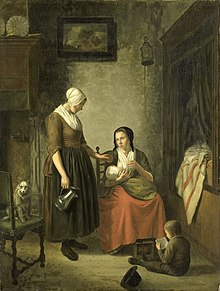
In the 18th century male person medical practitioners started to work on the areas of pregnancy, nascence and babies, areas traditionally dominated by women.[7] Also in the 18th century the emerging natural sciences argued that women should stay at home to nurse and raise their children, similar animals also exercise.[eight] Governments in Europe started to worry about the decline of the workforce because of the high mortality rates among newborns. Moisture nursing was considered ane of the main problems. Campaigns were launched against the custom amidst the college form to utilize a moisture nurse. Women were brash or even forced by police force to nurse their own children.[9] The biologist and medico Linnaeus, the English doctor Cadogan,[10] Rousseau, and the midwife Anel le Rebours described in their writings the advantages and necessity of women breastfeeding their own children and discouraged the practice of wet nursing. Sir Hans Sloane noted the value of breast-feeding in reducing babe mortality in 1748. His Chelsea manor which was later on converted to a botanic garden was visited by Carl Linnaeus in 1736.[xi] In 1752 Linnaeus wrote a pamphlet against the use of wet nurses. Linnaeus considered this against the law of nature. A baby not nursed by the mother was deprived of the laxative colostrum. Linnaeus thought that the lower class wet nurse ate as well much fat, drank alcohol and had contagious (venereal) diseases, therefore producing lethal milk.[12]

Cover of Linnaeus' Nutrix Noverca (1752)
Mother's milk was considered a miracle fluid which could cure people and give wisdom. The mythical effigy Philosophia-Sapientia, the personification of wisdom, suckled philosophers at her breast and by this way they captivated wisdom and moral virtue.[xiii] On the other mitt, lactation was what connected humans with animals. Linnaeus – who classified the realm of animals – did non by accident rename the category 'quadrupedia' (four footed) in 'mammalia' (mammals). With this act he made the lactating female breast the icon of this class of animals in which humans were classified.[14] [xv]
19th century [edit]
Historian Rima D. Apple writes in her book Mothers and Medicine. A Social History of Baby Feeding, 1890–1950 that in the U.s.a. of America most babies received breastmilk.[16] Dutch historian Van Eekelen researched the small amount of available evidence of breastfeeding practices in Kingdom of the netherlands. Around 1860 in the Dutch province of Zeeland about 67% of babies were nursed, merely there were big differences within the region.[17] Women were obliged to nurse their babies: "Every mother ought to nurse her own child, if she is fit to do it (...) no woman is fit to have a child who is non fit to nurse it."[18]
Female parent's milk was considered all-time for babies, just the quality of the breastmilk was found to exist varied. The quality of breastmilk was considered adept but if the mother had a adept diet, had physical practice and was mentally in residuum.[nineteen] In Europe (especially in France) and less in the Us it was a practice among the college and middle class to hire a wet nurse. If information technology was too difficult to find a moisture nurse, people used formula to feed their babies, but this was considered very unsafe for the health and life of the infant.[twenty]
Decline and resurgence in the 20th and 21st centuries [edit]
Breastfeeding in the Western earth declined significantly from the belatedly 1800s to the 1960s.[21] Past the 1950s, the predominant attitude to breastfeeding was that it was something proficient by the uneducated and those of lower classes. The practice was considered onetime-fashioned and "a picayune disgusting" for those who could not beget infant formula and discouraged by medical practitioners and media of the time.[2] Letters and editorials to Chatelaine from 1945 to as late every bit 1995 regarding breastfeeding were predominantly negative.[2] However, since the centre 1960s there has been a steady resurgence in the practice of breastfeeding in Canada and the United states, especially amidst more educated, affluent women.[ii]
In 2018, Transgender Wellness reported that a transgender woman in the United States breastfed her adopted babe; this was the kickoff known case of a transgender adult female breastfeeding.[22] [23]
Canada [edit]
A 1994 Canadian government health survey constitute that 73% of Canadian mothers initiated breastfeeding, upward from 38% in 1963. It has been speculated that the gap between breastfeeding generations in Canada contributes to the lack of success of those who do try it: new parents cannot wait to older family members for help with breastfeeding since they are also ignorant on the topic.[24] Ethnic women in Canada are particularly affected by their loss of traditional breastfeeding noesis, which taught mothers to breastfeed for at least 2 years and up to 4–five years subsequently birth, equally a issue of settler colonialism; Indigenous mothers now initiate breastfeeding and exclusively breastfeed for at to the lowest degree half-dozen months at significantly lower rates than non-Indigenous mothers in Canada.[25] [26] [27] [28] [29] Western Canadians are more than likely to breastfeed; but 53% of Atlantic province mothers breastfeed, compared to 87% in British Columbia. More than 90% of women surveyed said they breastfeed because it provides more than benefits for the infant than does formula. Of women who did not breastfeed, 40% said formula feeding was easier (the most prevalent answer). Women who were older, more than educated, had higher income, and were married were the virtually probable to breastfeed. Immigrant women were too more likely to breastfeed. About 40% of mothers who breastfeed do and so for less than three months. Women were most likely to discontinue breastfeeding if they perceived themselves to have bereft milk. Withal, among women who breastfed for more than iii months, returning to work or a previous decision to end at that time were the elevation reasons.
A 2003 La Leche League International written report found that 72% of Canadian mothers initiate breastfeeding and that 31% keep to do so past 4 to 5 months.[30]
A 1996 article in the Canadian Journal of Public Health found that, in Vancouver, 82.nine% of mothers initiated breastfeeding, but that this differed by Caucasian (91.vi%) and non-Caucasian (56.8%) women.[31] Just eighteen.2% of mothers breastfeed at nine months; breastfeeding practices were significantly associated with the mothers' marital status, teaching and family income.[31]
Republic of cuba [edit]
Since 1940, Republic of cuba'southward constitution has contained a provision officially recognising and supporting breastfeeding. Article 68 of the 1975 constitution reads, in role: During the six weeks immediately preceding childbirth and the six weeks following, a woman shall enjoy obligatory holiday from piece of work on pay at the same rate, retaining her employment and all the rights pertaining to such employment and to her labour contract. During the nursing menses, two extraordinary daily balance periods of a half 60 minutes each shall exist allowed her to feed her child.
Developing nations [edit]
In many countries, particularly those with a generally poor level of health, malnutrition is the major cause of death in children nether v, with 50% of all those cases being within the first yr of life.[32] International organisations such as Plan International and La Leche League have helped to promote breastfeeding around the globe, educating new mothers and helping the governments to develop strategies to increase the number of women exclusively breastfeeding.
Traditional beliefs in many developing countries give different advice to women raising their newborn kid. In Ghana babies are still frequently fed with tea alongside breastfeeding, reducing the benefits of breastfeeding and inhibiting the assimilation of atomic number 26, important in the prevention of anaemia.[33] [34] [35] [ failed verification ]
Publicity, promotion and law [edit]
In response to public pressure, the health departments of various governments have recognised the importance of encouraging mothers to breastfeed. The required provision of baby changing facilities was a big pace towards making public places more accessible for parents and in many countries there are now laws in place to protect the rights of a breastfeeding female parent when feeding her child in public.
The Earth Wellness Organization (WHO), along with grassroots not-governmental organisations like the International Babe Food Activeness Network (IBFAN) have played a large role in encouraging these governmental departments to promote breastfeeding. Nether this advice they take developed national breastfeeding strategies, including the promotion of its benefits and attempts to encourage mothers, particularly those nether the age of 25, to cull to feed their child with breast milk.
Regime campaigns and strategies effectually the world include:
- National Breastfeeding Week in the Britain
- The Section of Health and Ageing Breastfeeding Strategy in Australia
- The National Women's Health Information Center in the United states
- Earth Breastfeeding Week
Yet, there has been a long, ongoing struggle between corporations promoting artificial substitutes and grassroots organisations and WHO promoting breastfeeding. The International Code of Marketing of Breast-milk Substitutes was developed in 1981 by WHO, but violations have been reported by organisations, including those networked in IBFAN. In particular, Nestlé took 3 years before it initially implemented the code, and in the late 1990s and early 2000s was once more found in violation. Nestlé had previously faced a boycott, showtime in the U.S. simply soon spreading through the rest of the world, for marketing practices in the third world (see Nestlé boycott).
Breastfeeding in public [edit]
A breastfeeding mother in public with her baby will often need to breastfeed her child. A baby's demand to feed cannot be determined by a set schedule, so legal and social rules almost indecent exposure and apparel lawmaking are oft adapted to run into this need.[36] Many laws around the globe make public breastfeeding legal and disallow companies from prohibiting it in the workplace, but the reaction of some people to the sight of breastfeeding tin make things uncomfortable for those involved.[37] Some breastfeeding mothers experience reluctant to breastfeed in public.
United States [edit]
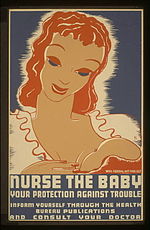
A United States House of Representatives appropriations bill (HR 2490) with a breastfeeding amendment was signed into law on September 29, 1999. It stipulated that no government funds may be used to enforce whatsoever prohibition on women breastfeeding their children in Federal buildings or on Federal belongings. Further, U.S. Public Law 106-58 Sec. 647 enacted in 1999, specifically provides that "a woman may breastfeed her kid at any location in a Federal building or on Federal holding, if the woman and her child are otherwise authorized to be present at the location." A bulk of states take enacted state statutes specifically permitting the exposure of the female chest by women breastfeeding infants, or exempting such women from prosecution nether applicative statutes,[38] [39] such as those regarding indecent exposure.
Well-nigh, only non all, state laws have affirmed the same right in their public places. Past June 2006, 36 states had enacted legislation to protect breastfeeding mothers and their children. Laws protecting the right to nurse aim to modify attitudes and promote increased incidence and elapsing of breastfeeding.[39] Recent attempts to codify a kid'southward right to nurse were unsuccessful in W Virginia and other states.[40] Breastfeeding in public is legal in all l U.S. states and the District of Columbia.[38]
Uk [edit]
A UK Department of Health survey found that 84% find breastfeeding in public acceptable if information technology is done discreetly; however, 67% mothers are worried about full general stance being against public breastfeeding.[41] In Scotland, a bill safeguarding the freedom of women to breastfeed in public was passed in 2005 by the Scottish Parliament.[42] The legislation allows for fines of up to £2500 for preventing breastfeeding in legally permitted places.[43]
Canada [edit]
In Canada, the Canadian Charter of Rights and Freedoms gives some protection under sex equality. Although Canadian homo rights protection does not explicitly include breastfeeding, a 1989 Supreme Courtroom of Canada decision (Brooks v. Safeway Canada) set the precedent for pregnancy as a condition unique to women and that thus discrimination on the ground of pregnancy is a class of sex discrimination. Canadian legal precedent also allows women the right to blank their breasts, just as men may. In British Columbia, the British Columbia Human Rights Commission Policy and Procedures Manual protects the rights of female workers who wish to breastfeed.
Recent global uptake [edit]
| | This section needs to be updated. (September 2015) |

The following table shows the uptake of exclusive breastfeeding.[44] [45]
| Country | Percentage | Yr | Type of feeding |
|---|---|---|---|
| Armenia | 0.7% | 1993 | Sectional |
| 20.eight% | 1997 | Exclusive | |
| Benin | xiii% | 1996 | Exclusive |
| sixteen% | 1997 | Sectional | |
| Bolivia | 59% | 1989 | Sectional |
| 53% | 1994 | Exclusive | |
| Fundamental African Republic | 4% | 1995 | Exclusive |
| Chile | 97% | 1993 | Predominant |
| Republic of colombia | nineteen% | 1993 | Sectional |
| 95% (16%) | 1995 | Predominant (exclusive) | |
| Dominican Republic | xiv% | 1986 | Exclusive |
| 10% | 1991 | Exclusive | |
| Ecuador | 96% | 1994 | Predominant |
| Egypt | 68% | 1995 | Exclusive |
| Federal democratic republic of ethiopia | 78% | 2000 | Sectional |
| Mali | eight% | 1987 | Exclusive |
| 12% | 1996 | Exclusive | |
| Mexico | 37.5% | 1987 | Sectional |
| Niger | 4% | 1992 | Sectional |
| Nigeria | 2% | 1992 | Exclusive |
| Pakistan | 12% | 1988 | Exclusive |
| 25% | 1992 | Exclusive | |
| Poland | 1.5% | 1988 | Exclusive |
| 17% | 1995 | Exclusive | |
| Kingdom of saudi arabia | 55% | 1991 | Exclusive |
| Senegal | seven% | 1993 | Exclusive |
| South Africa | 10.4% | 1998 | Exclusive |
| Sweden | 55% | 1992 | Exclusive |
| 98% | 1990 | Predominant | |
| 61% | 1993 | Exclusive | |
| Thailand | 90% | 1987 | Predominant |
| 99% (0.2%) | 1993 | Predominant (sectional) | |
| 4% | 1996 | Sectional | |
| U.k.[46] | 62% | 1990 | |
| 66% | 1995 | ||
| Republic of zambia | thirteen% | 1992 | Exclusive |
| 23% | 1996 | Exclusive | |
| Republic of zimbabwe | 12% | 1988 | Exclusive |
| 17% | 1994 | Exclusive | |
| 38.9% | 1999 | Exclusive |
Alternatives [edit]
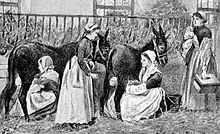
Straight udder nursing 1895
If a mother cannot feed her baby herself, and no moisture nurse is bachelor, then other alternatives have to be constitute, normally animal milk. In add-on, one time the mother begins to wean her child, the first food is very important.
Feeding vessels dating from about 2000 BC accept been institute in Egypt. A female parent holding a very modern-looking nursing canteen in 1 hand and a stick, presumably to mix the food, in the other is depicted in a relief found in the ruins of the palace of King Ashurbanipal of Nineveh, who died in 888 BC.[47] Clay feeding vessels were found in graves with infants from the get-go to fifth centuries Advertizement in Rome.[48]
Valerie Fildes writes in her book Breasts, bottles and babies. A history of Infant Feeding virtually examples from the 9th to 15th centuries of children getting creature's milk. In the 17th and 18th century Icelandic babies got cow's milk with cream and butter.[49] Human–animate being breastfeeding shows that many babies were fed more or less directly from animals, especially goats.
In 1582, the Italian physician Geronimo Mercuriali wrote in De morbis mulieribus (On the diseases of women) that women mostly finished breastfeeding an babe exclusively after the third month and entirely around 13 months of historic period.[fifty]
The feeding of flour or cereal mixed with broth or water became the next culling in the 19th century, but in one case again quickly faded. Around this fourth dimension there became an obvious disparity in the feeding habits of those living in rural areas and those in urban areas. Most likely due to the availability of culling foods, babies in urban areas were breastfed for a much shorter length of time, supplementing the feeds earlier than those in rural areas.
Though outset developed by Henri Nestlé in the 1860s, baby formula received a huge boost during the post–World War II infant boom. When business and births decreased, and government strategies in industrialised countries attempted to highlight the benefits of breastfeeding, Nestlé and other such companies focused their ambitious marketing campaigns on developing countries. In 1979 the International Babe Nutrient Action Network (IBFAN) was formed to help raise awareness of such practices as supplementary feeding of new babies with formula and the inappropriate promotion of infant formula, and to help change attitudes that discourage or inhibit mothers from breastfeeding their babies.
See also [edit]
- Nursing chair
- Weaning
- Human milk banking in North America
- Postpartum confinement, a system of recovery from childbirth that allows for mother and baby to learn how to nurse
References [edit]
- ^ a b c Stevens, Emily East.; Patrick, Thelma E.; Pickler, Rita (2009). "A History of Babe Feeding". Journal of Perinatal Instruction. 18 (ii): 32–9. doi:10.1624/105812409X426314. PMC2684040. PMID 20190854.
- ^ a b c d due east Nathoo, Tasnim; Ostry, Aleck (2009). The One Best Way?: Breastfeeding History, Politics, and Policy in Canada. Wilfrid Laurier Univ. Press. ISBN978-1-55458-171-9. [ page needed ]
- ^ Larco Hoyle, Rafael. Los Mochicas. Museo Arqueológico Rafael Larco Herrera 2001. ISBN 9972-9341-0-1
- ^ Payne, Cynthia, IBCLC. "Japanese Culture and Breastfeeding." New Ancestry, Vol. xx No. 5, September–October 2003, pp. 181
- ^ "Surat Al-Baqarah [ii:233] - The Noble Qur'an - القرآن الكريم". Quran.com. Retrieved May xix, 2015. , Quran Surah Al-Baqara ( Verse 233 )
- ^ "Surat Al-'Ahqaf [46:15] - The Noble Qur'an - القرآن الكريم". Quran.com. Retrieved May 19, 2015. , Quran Surah Al-Ahqaf ( Verse fifteen )
- ^ Schiebinger, Londa (1993). Nature's Body. Gender in the Making of Modern Science. Boston: Buoy Press. Page 69
- ^ Schiebinger, Londa (1993). Nature'due south Body. Gender in the Making of Modernistic Science. Boston: Beacon Printing. Pages 41–42
- ^ Schiebinger, Londa (1993). Nature's Body. Gender in the Making of Modern Science. Boston: Buoy Printing. Page 68
- ^ "Neonatology on the Web: Cadogan - An Essay upon Nursing - 1749". Neonatology.org. Retrieved May nineteen, 2015.
- ^ Dunn, P.Yard. (2001). "Sir Hans Sloane (1660-1753) and the value of breast milk". Archives of Disease in Babyhood: Fetal and Neonatal Edition. 85 (1): 73–74. doi:10.1136/fn.85.one.F73. PMC1721277. PMID 11420330.
- ^ Schiebinger, Londa (1993). Nature's Torso. Gender in the Making of Modernistic Science. Boston: Beacon Press. page 68
- ^ Schiebinger, Londa (1993). Nature'southward Body. Gender in the Making of Modernistic Science. Boston: Beacon Press. Page sixty
- ^ Schiebinger, Londa (1993). Nature'southward Body. Gender in the Making of Mod Science. Boston: Beacon Press. page xl
- ^ "Baby Food". The New Yorker. Jan 19, 2009. Retrieved May 19, 2015.
- ^ Apple tree 1987: 16
- ^ Knecht-van Eekelen, A. de. (1984). Naar een rationele zuigelingenvoeding. Voedingsleer en kindergeneeskunde in Nederland (1840–1914). Proefschrift. Nijmegen: Thieme. Page 222
- ^ Apple, Rima D. (1987). Mothers and Medicine. A Social History of Infant Feeding, 1890–1950. Wisconsin: University of Wisconsin Press. Page iii
- ^ Apple, Rima D. (1987). Mothers and Medicine. A Social History of Baby Feeding, 1890–1950. Wisconsin: University of Wisconsin Press. Pages half-dozen–7
- ^ Apple, Rima D. (1987). Mothers and Medicine. A Social History of Infant Feeding, 1890–1950. Wisconsin: University of Wisconsin Press. Folio iv
- ^ Riordan, J; Countryman, BA (July–August 1980), "Nuts of breastfeeding. Office I: Babe feeding patterns by and present.", JOGN Nursing, nine (four): 207–210, doi:ten.1111/j.1552-6909.1980.tb02778.ten, PMID 7001126
- ^ Reisman, Tamar; Goldstein, Zil (2018). "Example Report: Induced Lactation in a Transgender Woman". Transgender Health. 3 (1): 24–26. doi:10.1089/trgh.2017.0044. PMC5779241. PMID 29372185.
- ^ Hamzelou, Jessica (February xiv, 2018). "Transgender adult female is showtime to be able to breastfeed her baby". New Scientist. doi:ten.1089/trgh.2017.0044. PMC5779241 . Retrieved February 21, 2018.
- ^ "Rates of Breastfeeding" (PDF). Canadian Perinatal Wellness Report 2003. Archived from the original (PDF) on November 16, 2009. Retrieved January 26, 2007.
- ^ Romano, Isabella. "Breastfeeding, Aboriginal Practices". healthyweightsconnection.ca. Healthy Weights Connection. Retrieved March 7, 2019.
- ^ Bélanger, Ginette; Dumas, Louise. "First Infant-Friendly Aboriginal Eye in Canada" (PDF). breastfeedingcanada.ca . Retrieved March 7, 2019.
- ^ La Leche League Canada. "Thursday Tip: Breastfeeding and Beginning Nations Families in Canada". lllc.ca . Retrieved March vii, 2019.
- ^ All-time Start Resources Heart. "Breastfeeding for the Health and Future of our Nation: A Booklet for Indigenous Families" (PDF). beststart.org. HealthNexus. Retrieved March seven, 2019.
- ^ BFI Strategy for Ontario. "The Infant-Friendly Initiative: Strengthening Indigenous Families and Communities". Youtube.ca . Retrieved March 7, 2019.
- ^ "Breastfeeding Statistics". LLLI Center for Breastfeeding Information. September xv, 2003. Archived from the original on May 19, 2015. Retrieved January 26, 2007.
- ^ a b Williams P, Innis Due south, Vogel A (1996). "Breastfeeding and weaning practices in Vancouver". Can J Public Health. 87 (four): 231–vi. PMID 8870300.
- ^ Shrimpton R (2003). "Preventing depression birthweight and reduction of child mortality". Trans R Soc Trop Med Hyg. 97 (one): 39–42. doi:ten.1016/S0035-9203(03)90015-0. PMID 12886803.
- ^ Abbaspour, Nazanin; Hurrell, Richard; Kelishadi, Roya (2014). "Review on iron and its importance for man health". Journal of Enquiry in Medical Sciences. 19 (2): 164–174. PMC3999603. PMID 24778671.
- ^ Aborigo, Raymond Akawire; Moyer, Cheryl A.; Rominski, Sarah; Adongo, Philip; Williams, John (2012). "Infant diet in the first seven days of life in rural northern Ghana". BMC Pregnancy Childbirth. 12: 76. doi:10.1186/1471-2393-12-76. PMC3490996. PMID 22857600.
- ^ Elliott, Jane (April 25, 2003). "Breastfeeding could relieve lives". BBC News . Retrieved January 26, 2007.
- ^ "Breastfeeding Legislation in the The states: A General Overview and Implications for Helping Mothers". LEAVEN. 41 (3): 51–4. 2005.
- ^ Jordan, Tim; Pile, Steve, eds. (2002). Social Change. Blackwell. p. 233. ISBN978-0-631-23311-4.
- ^ a b "fifty Land Summary of Breastfeeding Laws". National Briefing of State Legislatures. Archived from the original on April 29, 2009. Retrieved April xiv, 2007.
- ^ a b Baldwin EN; Harvey S; Vance MR. "Current Summary of Breastfeeding Legislation in the US". La Leche League International. Archived from the original on March 28, 2007. Retrieved January 23, 2007.
- ^ White A. "W Virginia Legislative Setback". Retrieved April 14, 2007.
- ^ "Myths stop women giving babies the best start in life" (Press release). UK Department of Health. May 10, 2004. Retrieved Feb xvi, 2007.
- ^ "Breastfeeding etc. (Scotland) Act 2005". Queen's Printer for Scotland. February ten, 2005. Retrieved January 24, 2007.
- ^ "MSPs corroborate breastfeeding move". BBC News. September 23, 2004. Retrieved January 24, 2007.
- ^ "WHO Global Data Bank on Infant and Young Child Feeding". Who.int. Archived from the original on March 23, 2006. Retrieved May 19, 2015.
- ^ [one] Archived April five, 2007, at the Wayback Auto
- ^ [2] Archived Jan eight, 2007, at the Wayback Car
- ^ Brennemann J., Artificial feeding of infants. In: Abt IA, ed. Pediatrics. Philadelphia: W.B. Saunders Co., 1923. Folio 622. 16. Laubengayer BW. The evolution of the art of babe feeding in relation to the development of the science of nutrition. Thesis, Ithaca, NY: Cornell, 1935.
- ^ Dunne, J; Rebay-Salisbury, K; Salisbury, RB; Frisch, A; Walton-Doyle, C; Evershed, RP (2019). "Milk of ruminants in ceramic infant bottles from prehistoric child graves". Nature. 574 (7777): 246–248. Bibcode:2019Natur.574..246D. doi:10.1038/s41586-019-1572-x. hdl:1983/fe4e378a-bfc6-4b0a-8c00-7ef4a49dba0d. PMID 31554964. S2CID 202760220. Retrieved October 22, 2020.
- ^ Hastrup 1992: 91. In: Vanessa Maher (ed.). The anthropology of chest-feeding. Natural constabulary or social construct. Oxford: Berg.
- ^ Mercuriali, Geronimo (1582). De morbis mulieribus (On the diseases of women) .
Source: https://en.wikipedia.org/wiki/History_and_culture_of_breastfeeding

Post a Comment for "In What Ways Does Breastfeeding Impact Families and Societies?"