Renaissance Humanism was an intellectual movement typified by a revived interest in the classical world and studies which focussed not on religion only on what it is to be human. Its origins went back to 14th-century Italy and such authors every bit Petrarch (1304-1374) who searched out 'lost' aboriginal manuscripts. Past the 15th century, humanism had spread across Europe.
Humanists believed in the importance of an education in classical literature and the promotion of civic virtue, that is, realising a person's full potential both for their own skillful and for the practiced of the society in which they live. The difficulty in defining humanism and its ever-evolving character have not prevented it being widely regarded equally the defining characteristic of 1400 to 1600 Europe and the very reason why that period can be identified every bit a Renaissance or 'rebirth' of ideas.
Defining Humanism
Humanism was a term invented in the 19th century to describe the Renaissance idea that direct studying the works of antiquity was an of import role of a rounded education (only not the only part). From this position came the thought that the study of humanity should exist a priority every bit opposed to religious matters (which demand non be neglected or contradicted by humanist studies). Important classical ideals which interested humanists included the importance of public and private virtue, Latin grammar, techniques of rhetoric, history, conventions in literature and verse, and moral philosophy. This teaching did not create an all-encompassing philosophy or worldview in its adherents. Someone who had a humanist instruction might exist a Catholic or a Protestant, for example, and many students went on to study very different branches of thought such as theology, law, or medicine.
The thought actually took off that the ancient world had something very valuable to teach the people of the 15th century.
In modernistic times, the term 'humanism' has gained a different meaning (a rational and not-religious style of life) and so to safeguard its original purpose, when practical to 1400-1600, information technology is often clarified as 'Renaissance Humanism'. It is of import to retrieve, though, that Renaissance thinkers did not themselves utilize the term humanism, and neither did they agree on all subjects. Due to these problems of definition, some historians prefer to use the term studia humanitatis, coined by the Roman statesman Cicero (106-43 BCE) and revived past the Florentine scholar Coluccio Salutati (1331-1406). Studia humanitatis refers to studies which, rather than concentrating on religious matters, focus instead on what it is to exist man, and more precisely, consider what is a virtuous individual in its widest sense and how may that individual fully participate in public life.
The main elements of Renaissance humanism include:
an interest in studying literature and art from antiquity
an interest in the eloquent use of Latin and philology
a belief in the importance and ability of instruction to create useful citizens
the promotion of private and borough virtue
a rejection of scholasticism
the encouragement of non-religious studies
an emphasis on the individual and their moral autonomy
a conventionalities in the importance of ascertainment, critical analysis, and creativity
a conventionalities that poets, writers, and artists can lead humanity to a better way of living
an interest in the question 'what does it hateful to be human'?
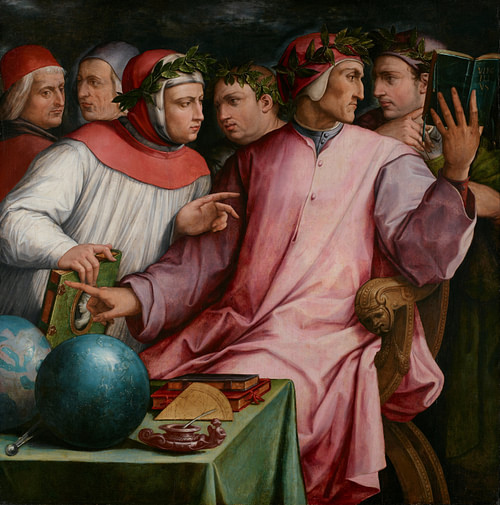
Six Tuscan Poets by Vasari
Minneapolis Constitute of Fine art (Public Domain)
Origins of the Classical Revival
The humanist motion can be traced back to a trio of Italian authors who lived before the Renaissance catamenia had even begun: Dante Alighieri (1265-1321 CE), Petrarch, and Giovanni Boccaccio (1313-1375). All three would receive new involvement in their work during the Renaissance when they were recognised as its founding fathers. Dante was the beginning, and his Divine Comedy (c. 1319), although a book with a central message on how to reach salvation, was a subtle shift from entirely religious-focussed works to those considering humanity'southward function in God'due south universe. The Divine Comedy had many overtly classical elements, from the Roman poet Virgil (lxx-nineteen BCE) interim as a guide to the many aboriginal historical figures mentioned.
Love History?
Sign up for our free weekly electronic mail newsletter!
Next came Petrarch, who was an equally religious man just in his piece of work criticised some elements of the Catholic Church such as its corruption and excessive dearest of show. Petrarch rejected scholasticism which grimly held on to Church building dogma and created countless rounds of fruitless debate amongst scholars. He fabricated possibly his greatest contribution to the report of antiquity by finding manuscripts which had become 'lost' in obscure monastic libraries. Amongst his famous discoveries were several works and letters by Cicero.
Greek scholars fled the collapsing Byzantine Empire & brought classical texts with them to Europe.
Petrarch believed that a new golden age of thought and politics could exist achieved by returning to the ideals of antiquity and past permitting poets and scholars to lead a revolution in education. His idea that the period in which he lived was an intermediary menstruum between antiquity and this new dawn, what he called disparagingly 'a sleep' was latched onto by later Renaissance thinkers and did much to foster the idea that the Middle Ages was somehow a menses of cultural darkness. Further, Petrarch's piece of work with ancient manuscripts encouraged the scholarship of non-religious subjects with humanity at its middle, and this became a legitimate activity for intellectuals. Consequently, Petrarch is often cited as the begetter of humanism.
Giovanni Boccaccio also searched out 'lost' manuscripts relevant to artifact. In improver, his Decameron (10 Days), a collection of tales compiled between c. 1348 and 1353, appealed to later humanists because it dealt with everyday human experiences in great detail. Bocaccio also created works that were of nifty use to humanist scholars such as his Beginnings of the Pagan Gods.
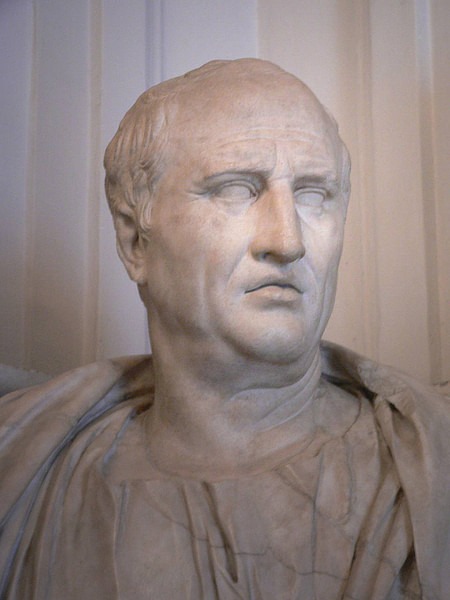
Cicero
Mary Harrsch (Photographed at the Capitoline Museum) (CC Past-NC-SA)
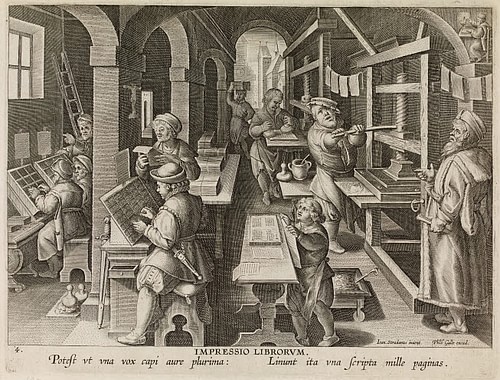
All 3 of these writers promoted the use of the Tuscan colloquial (at least in poetical works), and this somewhen led to the dominance of Latin being challenged. Humanists, though, connected to favour Latin for scholarly purposes and modelled their Latin on that of Cicero for prose and Virgil for poetry. The arrival of the press press in Europe in 1450 was another boost to the trio of authors mentioned in a higher place and the democratisation of knowledge. Renaissance humanism gave great importance to invention, and here, again, Dante with his creation of terza rima (poems formed of stanzas of iii rhyming lines) and Boccaccio'due south innovative promotion in written form of the ottava rima (where stanzas are formed of 8 11-syllable lines) fit that sentiment perfectly.
The Classical Ideal
After the autumn of Constantinople in 1453, many Greek scholars fled the collapsing Byzantine Empire and brought classical texts with them to Europe, particularly Italy. These were a very welcome improver to the Latin texts scholars like Petrarch had constitute in monastic libraries. Consequently, past 1515 the works of all major classical authors were available in print. Looking at these works as a whole, one idea which especially interested Renaissance thinkers was virtus (virtue or excellence) and civic duty. Petrarch had studied this half a century earlier but now the thought really took off that the ancient globe had something very valuable to teach the people of the 15th century. Renaissance humanists at present wanted to use, analyse, and critique aboriginal sources to improve one'south public life in service of the state. Theoretical knowledge was not enough, what was gained from study had to be put into practice for the good of the country and all who lived in information technology. Consequently, the bang-up question, what does information technology hateful to exist homo that preoccupied Renaissance scholars provoked answers that included religious, philosophical, scientific, and artistic considerations.
Information technology today seems rather odd that scholars took such an interest in ancient sources which might be considered outdated and irrelevant to contemporary society. For humanist thinkers, though, artifact, as seen in so many newly discovered manuscripts, presented a fresh and vibrant culling to the stagnant pool of thought so jealously guarded by the medieval church. The new horizons offered by these texts and the seemingly unbiased arroyo of ancient scholars in discussing and explaining the world without any preconceived ideas made the whole Renaissance process seem, like its very proper noun indicates, an intellectual rebirth. Humanist scholars were not uncritical of ancient sources, on the contrary, but like many ancient thinkers, they approached whatsoever subject field with critical analysis. Further, to approach a given discipline objectively, one must exist intellectually gratis and with this thought came that of the free-thinking individual, ane unrestrained past religious or political bias. In that location were even those who thought that God had given humanity the world equally a test, to make of it what they will and apply their virtue into making information technology a better place. In this manner, humanism was not in opposition to religion for many thinkers, but it did atomic number 82 to the idea of a morally-autonomous private, which in turn led to individualism.
16th Century CE Flemish Volume Printer
The British Museum (CC By-NC-SA)
There was yet some other reason to admire the ancients: their eloquence of argument. Cicero was taken as the case par excellence of superb writing in Latin. Rhetoric - another term that modernity has twisted out of all recognition from its original pregnant - was and so the art of presenting eloquent argument. Farther, this was non merely a flim-flam to be used by scholars in their writing, this was a tool to exist used in everyday life. In other words, rhetoric is persuasion, and with persuasion comes power. Rhetoric could become the ways by which humanists spread their ideas, persuading everyone from a literate merchant to the ruler of a dukedom that theirs was the all-time way to be educated, live, work, and rule.
The Spread of Humanism
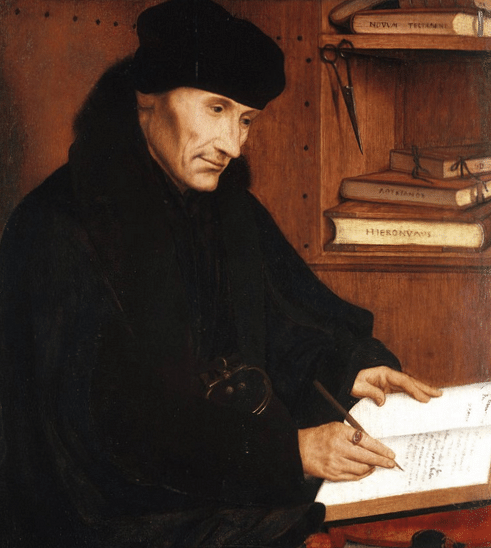
The printing press helped spread humanist ideas from their origins in Italy to the north of Europe. Indeed, the most historic humanist scholar of his twenty-four hour period was Desiderius Erasmus of Rotterdam (c. 1469-1536). Erasmus believed that didactics was the answer to the Catholic Church'south problems (and non a radical Reformation). To this end, he compiled editions of classical authors and provided a new Latin and Greek translation of the New Testament. Erasmus' precipitous and critical examination of original texts to produce this, his textual analysis of electric current versions, and his interest in philology would be influential on other Renaissance scholars.
Although early humanists were often Christians, the motion's emphasis on critical inquiry did lead to an inevitable disharmonism with Church authorities who depended on mass and uncritical acceptance of secondhand interpretations of doctrine. That some humanist scholars became champions of heathen texts was some other bone of contention.
Desiderius Erasmus past Matsys
Quentin Matsys (Public Domain)
In the north of Europe, humanist scholars were more interested in religious reforms compared to elsewhere, hence their brand of humanism is oft chosen Religious Humanism. Sir Thomas More (1478-1535), the English scholar and statesman, was one figure in this movement. A defender of the Cosmic Church against the Reformists, he famously wrote Utopia in 1516 about an ideal society attack an imaginary island. More probable intended the work as a thinly-veiled criticism of the reign of Henry Eight of England (r. 1509-1547), but its radical presentation of a society where everyone works for the common good and shares every bit in its success rang a notation of recognition in the minds of humanist scholars elsewhere. The obvious link with Plato's Republic was another bespeak of favour with the classical-loving humanists.
A Humanist Pedagogy
Erasmus was of import in i other surface area: education for everybody. It was all very well for scholars to fence the ethics of education in theory simply more applied offerings were needed to achieve the humanist goal of widening instruction. Erasmus, therefore, wrote many textbooks such as his hugely pop On Copia (1512), which taught students how to debate, revise texts, and produce new ones. His 1521 On Writing Letters taught how to all-time write letters, aim for specific audiences, and apply eloquent expressions. Erasmus fifty-fifty produced guides for those wishing to institute a school and compiled recommended syllabuses.
Humanists emphasised the importance of an education which covered the liberal arts of rhetoric, moral philosophy, grammar, history, and poesy. Physical do, just like in ancient Greece, was as well considered an essential part of a rounded educational activity that resulted in immature people beingness able to realise their potential and become skilful citizens. In add-on, a humanist instruction continued for life, and it was never too late to learn its benefits, especially so for rulers.
Humanism in Science
Observing, analysing, and categorising the world around united states of america was an important role of humanist thought, just as it had been in artifact. For this reason, science made keen leaps forward during the Renaissance, powered at starting time past developments in mathematics. The Polish astronomer Nicolaus Copernicus (1473-1543) proposed that the solar arrangement was heliocentric, amongst other innovative ideas, in his On the Revolutions of the Heavenly Spheres, published in 1543. Copernicus was a archetype Renaissance scholar equally he studied the works of artifact, observed what he could in the earth personally, collated all that had been studied thus far in his field, and so came up with a new view of the field of study at mitt. Perhaps the greatest contribution humanism made to scientific discipline was its thirst for answers and the confidence that they could be constitute through man endeavour.
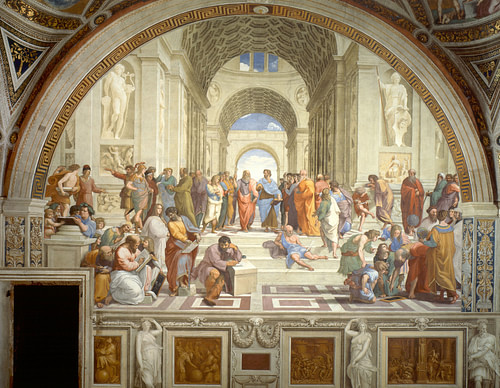
The School of Athens past Raphael
Raphael (Public Domain)
Humanism in the Arts
Rulers like Federico da Montefeltro (1422-1482 in Urbino and Cosimo I de' Medici (1519-1574) in Florence were bang-up admirers of artifact and built up impressive humanist libraries. They were, too, collectors of ancient art such as sculpture, sarcophagi, relief panels, and coins. Both men also became great patrons of the arts, encouraging humanist artists. This was a pattern imitated by rulers across Europe.
Renaissance painters and sculptors became very interested in classical mythology, sometimes even combining it with Christian themes such every bit subtly representing Venus as the Virgin Mary. Aboriginal thinkers were direct represented in art, perhaps most famously in the School of Athens fresco in the Vatican by Raphael (1483-1520).
There was, too, an appreciation of the skill of ancient artists, especially sculptors and their ability to capture reality in bronze or marble. Renaissance artists were not bad to capture this reality themselves, a procedure going back as early equally Giotto (b. 1267 or 1277 - d. 1337) and culminating with the hyper-realistic portraits by late Renaissance Netherlandish artists. Only like Renaissance writers, artists wanted not only to emulate the classical tradition but also to improve upon it. Consequently, the correct utilize of perspective became an e'er-more precise attempt for Renaissance artists. Artists were as well convinced that their aboriginal counterparts had somehow discovered mathematical secrets of proportion, especially related to the human body.
Artists now gave emphasis to the human experience in their art. Portraits, for case, might include a classical volume next to the sitter to emphasise their humanist tendencies. Fifty-fifty religious works of the menstruum accept a focus on the human figures and their story within the scene. Just equally humanist writers knew full well the powerful consequence of their words, and so, too, artists knew the ability they had to create a lasting aesthetic impression on the viewer. Perhaps there is no better example of this wow-gene than Michelangelo's Sistine Chapel ceiling. Finally, the emphasis on the individual within humanism found expression in the style artists now viewed themselves - superior artisans who used their intellect to study art and create masterpieces that would carry their fame for generations to come up.
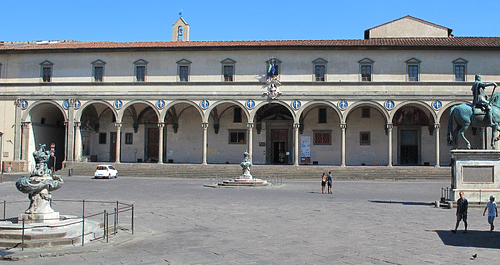
Loggia of Ospedale degli Innocenti by Brunelleschi
Sailko (CC By-SA)
Humanism pervaded Renaissance architecture where buildings were designed that were elegant, symmetrical, functional, and harmonious with their environs, just every bit they had been in ancient Rome. Above all, buildings displayed the classical ratios of length and peak.
Humanism, with its reverence for classical authors and what exactly a knowledge of artifact can teach the states plant expression in the performance arts, notably in the plays of William Shakespeare (1564-1616) who was interested in characters that could reveal the latitude and depth of the homo experience. Shakespeare is not possibly taking any particular side in the humanist debates presented in his works but he does, at least, fill up masterly use of that humanist ability tool - language - to achieve his effects.
The Legacy of Renaissance Humanism
Humanism transformed education and rejuvenated the world of ideas and art with its discovery, promotion, and adaptation of classical works. It led to the cosmos of an international network of scholars linked past letters and books, the separation of church and politics, the critical examination of texts leading to the discovery of inaccuracies and fifty-fifty forgeries, and the creation of public libraries.
Perhaps inevitably, though, humanist scholars and thinkers began to split into groups as they specialised into different areas of what was already a hopelessly broad surface area of homo endeavor. There were realists against moralists, those who wanted to forget all most religion and those who did non, and those who were republicans and those who were royalists. There were humanists who thought the study of linguistic communication an stop itself while others thought it only a means to empathize ideas. Some preferred a life of contemplation in contrast to those who still stuck to the thought of putting humanism into political do. As science, the arts, history, philosophy, and theology all split away from each other, so Renaissance humanism came to an end, broken apart equally scholarly specialisation won the battle against earning a comprehensive overview of the homo condition.
Despite the breaking up of the humanist movement into its component parts, the essential idea that humans were worthy of serious study is ane that has never gone abroad, of form. If anything, this thought has but widened and deepened. The subjects that were considered important to study in classical sources such as philosophy, history, and literature came to be collectively known every bit the humanities, and today, of form, they class major faculties in colleges and universities worldwide.
Did you like this definition?
This article has been reviewed for accuracy, reliability and adherence to academic standards prior to publication.

Post a Comment for "300 Year Of Renewed Interest in Classical Learning and the Arts"