Neil Young I Wont Be Coming Back Again
| Comes a Time | ||||
|---|---|---|---|---|
 | ||||
| Studio album by Neil Young | ||||
| Released | October 21, 1978[1] | |||
| Recorded | November 28, 1975 – November 21, 1977 | |||
| Studio |
| |||
| Genre | Country folk[two] | |||
| Length | 37:15 | |||
| Label | Reprise | |||
| Producer | Neil Young, David Briggs, Ben Keith, Tim Mulligan | |||
| Neil Young chronology | ||||
| ||||
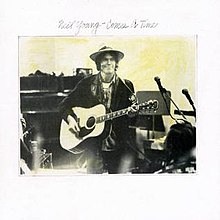
Comes a Time is the ninth studio album by Canadian-American vocalist-songwriter Neil Young, released past Reprise Records in October 1978. Its songs are written as moralizing discourses on love'south failures and recovering from worldly troubles. They are largely performed in a quiet folk and land manner, featuring bankroll harmonies sung by Nicolette Larson and boosted accompaniment on some songs by Crazy Horse.[iii]
Production [edit]

The album originally started out equally a solo record, simply when Immature played it for Reprise executives they asked him if he would consider adding rhythm tracks to what he already had. Young agreed, and the stop product was Comes a Time.
Much of the anthology features harmony vocals from Nicolette Larson, who besides shares lead vocals with Young on "Motorcycle Mama".[4] Two songs on the album, "Expect Out For My Love" and "Lotta Beloved", featured Young'south long-fourth dimension backing ring, Crazy Equus caballus.[ commendation needed ] Another song, "Homo Highway", was written several years prior to the album'southward release, and was originally recorded by Crosby, Stills, Nash & Young in 1974 for a proposed album to exist called "Human Highway", only in typical CSNY style the recording sessions were abandoned amid acrimony betwixt the four group members and the album never came to pass.[5]
For many years it was rumoured that Young had personally purchased some 200,000 vinyl copies of Comes a Time having been unhappy with the album's sound, owing to harm that occurred to the principal tape during shipment to the mixing facility. The version of the anthology most widely available today was personally remixed past Young from the safety copy of the original master. In a March 2014 interview with Rolling Stone, Young claimed that he, in fact, used the 200,000 LPs every bit shingles for a barn roof.[6]
Critical reception [edit]
| Review scores | |
|---|---|
| Source | Rating |
| AllMusic |   [7] [7] |
| Christgau'southward Tape Guide | A[viii] |
| Rolling Stone | [9] |
| Spin Alternative Record Guide | 9/10[10] |
| Tom Hull – on the Web | A[11] |
Reviewing for The Village Voice in October 1978, Robert Christgau hailed Comes a Fourth dimension as a "tour de strength" for its folkie concept and music, with melodies that rival those of Young's Afterwards the Gold Rush (1970) and a sound that is "almost ever quiet, commonly acoustic and drumless, and sweetened past Nicolette Larson". While noting that listeners may "wonder why this thirty-two-twelvemonth-erstwhile hasn't learned more about Long-Term Relationships", Christgau was ultimately won over by "the spare, good-natured balls of the singing and playing" for how information technology "deepens the more egregious homilies and transforms good sense into wisdom".[12] Stereo Review magazine'due south Noel Coppage found the anthology to be Young'due south "simplest, most audio-visual, and best produced" record since 1972'due south Harvest, but more "down to world and directly" in comparison and highlighted past a healthier perspective to his usual angst and varied songs performed in a consistent way. While lamenting a lack of energy to some degree, Coppage said that echo listens of the album will provide "rewarding experiences with texture and mood, some real tunes, and the existent personality Immature puts into his work".[xiii] Somewhat less impressed was Greil Marcus of Rolling Stone. Describing Comes a Time every bit "a restrained and modest fix of love songs that traces a long affair from showtime light to final regrets", he expressed disappointment at the relative "facelessness" of the songwriting when compared with rougher music on earlier albums like Zuma (1975) and American Stars 'n Confined (1977).[xiv]
At the end of 1978, Comes a Time was voted the year'south eighth best album in the Pazz & Jop, an annual poll of American critics nationwide, published in The Village Vox.[15] Christgau, the poll'due south supervisor, ranked information technology fifth on his own year-terminate list accompanying the poll.[16]
According to Rolling Stone 'southward Milo Miles, while the album may have sounded out of place amid the punk rock craze of 1978, it is in retrospect Young's "well-nigh timeless and easy-to-love works, a cursory just immaculate" work. Miles interprets the opening track "Goin' Back" as Young returning to folk music in refuge from the existent world, much as in the aforementioned way the anthology altogether offers listeners "a steady haven in dark times" with lyrics about "taking shelter from troubles and going out to face them again".[nine] AllMusic's William Ruhlmann recommended the anthology to fans of Harvest, proverb "melodies, beloved lyrics, lush arrangements, and steel guitar solos dominated, and Young'south vocals were made more accessible by being paired with Nicolette Larson's harmonies."[7]
Track listing [edit]
All songs are written past Neil Young, except where noted. Track numbering and timings are from the original vinyl release, MSK 2266.
Side one
- "Goin' Dorsum" – 4:43
- "Comes a Time" – 3:05
- "Look Out for My Dear" – four:06
- "Peace of Mind" – iv:06
- "Lotta Love" – 2:40
Side two
- "Human Highway" – 3:09
- "Already One" – 4:53
- "Field of Opportunity" – 3:08
- "Motorcycle Mama" – 3:08
- "Four Stiff Winds" (Ian Tyson) – four:07
Personnel [edit]
Musicians [edit]
- Neil Immature – guitar, harmonica, vocals, product
- Frank Sampedro – guitar, piano, vocals (on tracks 3 and 5)
- Baton Talbot – bass, vocals (on tracks 3 and 5)
- Ralph Molina – drums, vocals (on tracks 3 and 5)
- Tim Mulligan – saxophone
- Nicolette Larson – harmony / pb vocals (except on tracks 3 and five)
- Ben Keith – steel guitar
- Karl Himmel – drums
- Tim Drummond – bass
- Spooner Oldham – piano
- Rufus Thibodeaux – fiddle
- Joe Osborn – bass
- Larrie Londin – drums
- J. J. Cale – electric guitar
- Farrell Morris – percussion
- Rita Fey – autoharp
- Bucky Barrett, Grant Boatwright, Johnny Christopher, Jerry Shook, Vic Hashemite kingdom of jordan, Steve Gibson, Dale Sellers, Ray Edenton – audio-visual guitars
- Shelly Kurland, Stephanie Woolf, Marvin Altar, Roy Christensen, Gary Vanosdale, Carl Gorodetzky, George Binkley, Steven Smith, Larry Harvin, Larry Lasson, Ballad Walker, Rebecca Lynch, Virginia Christensen, Maryanna Harvin, George Kosmola, Martha McCrory, Chuck Cochran – strings
Technical [edit]
- Ben Keith – production (except on tracks iii, iv and 8)
- Tim Mulligan – product (except on track vii)
- David Briggs – product (on tracks iii and iv)
- Tim Mulligan, Michael Laskow, David McKinley, Danny Hilley, Mike Porter, Denny Purcell, Rich "Hoss" Adler, Ernie Winfrey, Gabby Garcia, Paul Kaminsky – engineering
- Elliot Roberts – direction
- Tom Wilkes – art direction
- Coley Coleman – photography
Charts [edit]
Weekly charts [edit]
| Chart (1978) | Peak position |
|---|---|
| Australia (Kent Music Report)[17] | 6 |
| U.s. Billboard Top LPs & Tape [eighteen] | 7 |
| UK Album Charts[19] | 42 |
| Canadian RPM 100 Albums[20] | iv |
| Finnish Album Charts[21] | 10 |
| French Album Charts[22] | ii |
| Japanese Anthology Charts[23] | 65 |
| Norwegian VG-lista Albums[24] | ix |
| New Zealand Album Charts[25] | 6 |
| Dutch MegaCharts Albums[25] | 3 |
| Us Cash Box Top 100 Albums[26] | 13 |
| US Record World Album Chart[27] | xiii |
Singles [edit]
| Yr | Unmarried | Chart | Position |
|---|---|---|---|
| 1979 | "Iv Potent Winds" | Billboard Pop Singles[28] | 61 |
| U.s. Cashbox Singles[29] | 69 | ||
| Us Tape World Singles[30] | 67 | ||
| Canadian RPM Top Singles[31] | 61 | ||
| UK Singles Chart | 57 |
Year End Nautical chart
| Year | Chart | Position |
|---|---|---|
| 1978 | Canadian Yr Finish Chart[32] | sixty |
| Cashbox Year End Chart[33] | 71 | |
| 1979 | Billboard Year Terminate Nautical chart[34] | 56 |
| New Zealand Albums (RMNZ)[35] | 44 |
Certifications [edit]
References [edit]
- ^ "Archived copy". Archived from the original on July 26, 2015. Retrieved August 22, 2017.
{{cite web}}: CS1 maint: archived copy equally title (link) - ^ Clark, Rick (1995). "Neil Young – Comes a Fourth dimension". All Music Guide to Stone. Miller Freeman. ISBN087930376X.
- ^ Shapiro, Bill (1991). "Neil Young". Rock & Roll Review: A Guide to Skilful Rock on CD. Andrews McMeel Publishing. ISBN0836262174.
Immature, effectively immersed in his land/folk mode, with a picayune assistance from Crazy Equus caballus and some less-than-successful harmony vocals from Nicolette Larson. Replete with pleasant melodies, quietly intense performances, and hard-bitten homilies virtually dear's losses ...
- ^ "Comes A Fourth dimension". Rolling Stone . Retrieved February 7, 2019.
- ^ Crosby, Stills, Nash and Young's Unreleased LP "Human Highway" | Talk From The Rock Room, http://neilyoungnews.thrasherswheat.org/2014/11/crosby-stills-nash-and-youngs.html
- ^ "Neil Immature on Pono, His New Album and Using LPs as Roof Shingles". Rolling Stone . Retrieved April nine, 2017.
- ^ a b Ruhlmann, William. Comes a Fourth dimension at AllMusic. Retrieved November thirteen, 2009.
- ^ Christgau, Robert (1981). "Consumer Guide '70s: Y". Christgau's Record Guide: Stone Albums of the Seventies. Ticknor & Fields. ISBN089919026X . Retrieved March 23, 2019 – via robertchristgau.com.
- ^ a b Miles, Milo (January 23, 2003). "The Rolling Stone Hall of Fame: The Greatest Albums Ever Made: Neil Young Comes a Fourth dimension > Album Review". Rolling Rock. No. 914. p. seventy. Archived from the original on September 30, 2007. Retrieved January 12, 2007. Posted at rollingstone.com Dec thirty, 2002.
- ^ Weisbard, Eric; Marks, Craig, eds. (1995). "Neil Immature". Spin Culling Record Guide. Vintage Books. ISBN0-679-75574-8.
- ^ Hull, Tom (n.d.). "Grade List: Neil Young". Tom Hull – on the Web . Retrieved Jan thirty, 2021.
- ^ Christgau, Robert (Oct xxx, 1978). "Christgau's Consumer Guide". The Village Vocalization . Retrieved January xxx, 2021 – via robertchristgau.
- ^ Coppage, Noel (Feb 1979). "Comes a Time". Stereo Review . Retrieved Jan thirty, 2021 – via Google Books.
- ^ Marcus, Greil (October 1978). "Neil Young Comes a Time > Album Review". Rolling Rock . Retrieved September 24, 2011. Posted at rollingstone.com January 2, 2002.
- ^ Christgau, Robert (January 22, 1979). "The 1978 Pazz & Jop Critics Poll". The Hamlet Voice . Retrieved January xxx, 2021 – via robertchristgau.com.
- ^ Christgau, Robert (Jan 22, 1979). "New Moving ridge Hegemony and the Bebop Question". The Hamlet Voice . Retrieved Jan xxx, 2021 – via robertchristgau.com.
- ^ Kent, David (1993). Australian Chart Book 1970–1992 (illustrated ed.). St Ives, Northward.S.W.: Australian Chart Book. p. 295. ISBN0-646-11917-6.
- ^ "Stephen Stills". Billboard . Retrieved July 5, 2020.
- ^ "STEPHEN STILLS | total Official Nautical chart History | Official Charts Company". www.officialcharts.com . Retrieved July 5, 2020.
- ^ Canada, Library and Archives (Apr xvi, 2013). "The RPM story". www.bac-lac.gc.ca . Retrieved July 5, 2020.
- ^ Sisältää hitin: Levyt ja esittäjät Suomen musiikkilistoilla vuodesta 1961.
- ^ "InfoDisc : Les Albums (Interprètes, Classements, Ventes, Certifications, Les Tops, Les N° one...)". www.infodisc.fr . Retrieved December 22, 2020.
- ^ "クロスビー,スティルス,ナッシュ&ヤングの売上ランキング". ORICON NEWS . Retrieved October 11, 2020.
- ^ "norwegiancharts.com - Norwegian charts portal". norwegiancharts.com . Retrieved June 21, 2020.
- ^ a b Hung, Steffen. "The Stills-Immature Band - Long May You Run". hitparade.ch . Retrieved June 21, 2020.
- ^ "Greenbacks BOX MAGAZINE: Music and coin machine magazine 1942 to 1996". worldradiohistory.com . Retrieved July 5, 2020.
- ^ "RECORD World Magazine: 1942 to 1982". worldradiohistory.com . Retrieved July 5, 2020.
- ^ Comes a Fourth dimension – Neil Young > Charts & Awards > Billboard Singles at AllMusic. Retrieved January 2, 2005.
- ^ "CASH BOX MAGAZINE: Music and coin machine magazine 1942 to 1996". worldradiohistory.com . Retrieved April iii, 2021.
- ^ "Record WORLD Mag: 1942 to 1982". worldradiohistory.com . Retrieved Apr 3, 2021.
- ^ "RPM Top 100 Singles - February thirteen, 1993" (PDF).
- ^ "Particular Display - RPM - Library and Athenaeum Canada". June nineteen, 2013. Archived from the original on June nineteen, 2013. Retrieved April 10, 2021.
- ^ "Cashbox Year End Chart 1978" (PDF). Archived (PDF) from the original on March 8, 2021.
- ^ "BILLBOARD MAGAZINE: American music magazine 1920'south to 2017". worldradiohistory.com . Retrieved January xiii, 2021.
- ^ "Pinnacle Selling Albums of 1979 — The Official New Zealand Music Nautical chart". Recorded Music New Zealand. Retrieved Jan 28, 2022.
- ^ "ARIA Charts – Accreditations – 1996 Albums" (PDF). Australian Recording Industry Association. Retrieved July 14, 2021.
- ^ "British album certifications – Neil Young – Comes A Time". British Phonographic Manufacture. Retrieved November 17, 2019.
- ^ "American album certifications – Neil Young – Comes A Fourth dimension". Recording Manufacture Clan of America. Retrieved November 17, 2019.
External links [edit]
- Comes a Fourth dimension at MySpace (streamed copy)
Source: https://en.wikipedia.org/wiki/Comes_a_Time

Post a Comment for "Neil Young I Wont Be Coming Back Again"